The Cubit is the oldest unit of length in recorded human history, originating in Mesopotamia and Egypt over 5,000 years ago. When copper wire is cut to a Cubit-derived proportion and joined end-to-end, the resulting ring resonates at a specific frequency — a finding documented by researcher Slim Spurling in the 1990s. This is the heart of how Tensor Rings work according to the Spurling tradition.
This article combines archaeologically documented ancient history + verifiable geometric mathematics + field research from Slim Spurling and Hans Becker in the 1990s, which lies outside mainstream science. Readers will get both an overview of historical Cubit traditions and an understanding of why the Cubit matters in Tensor Ring work.
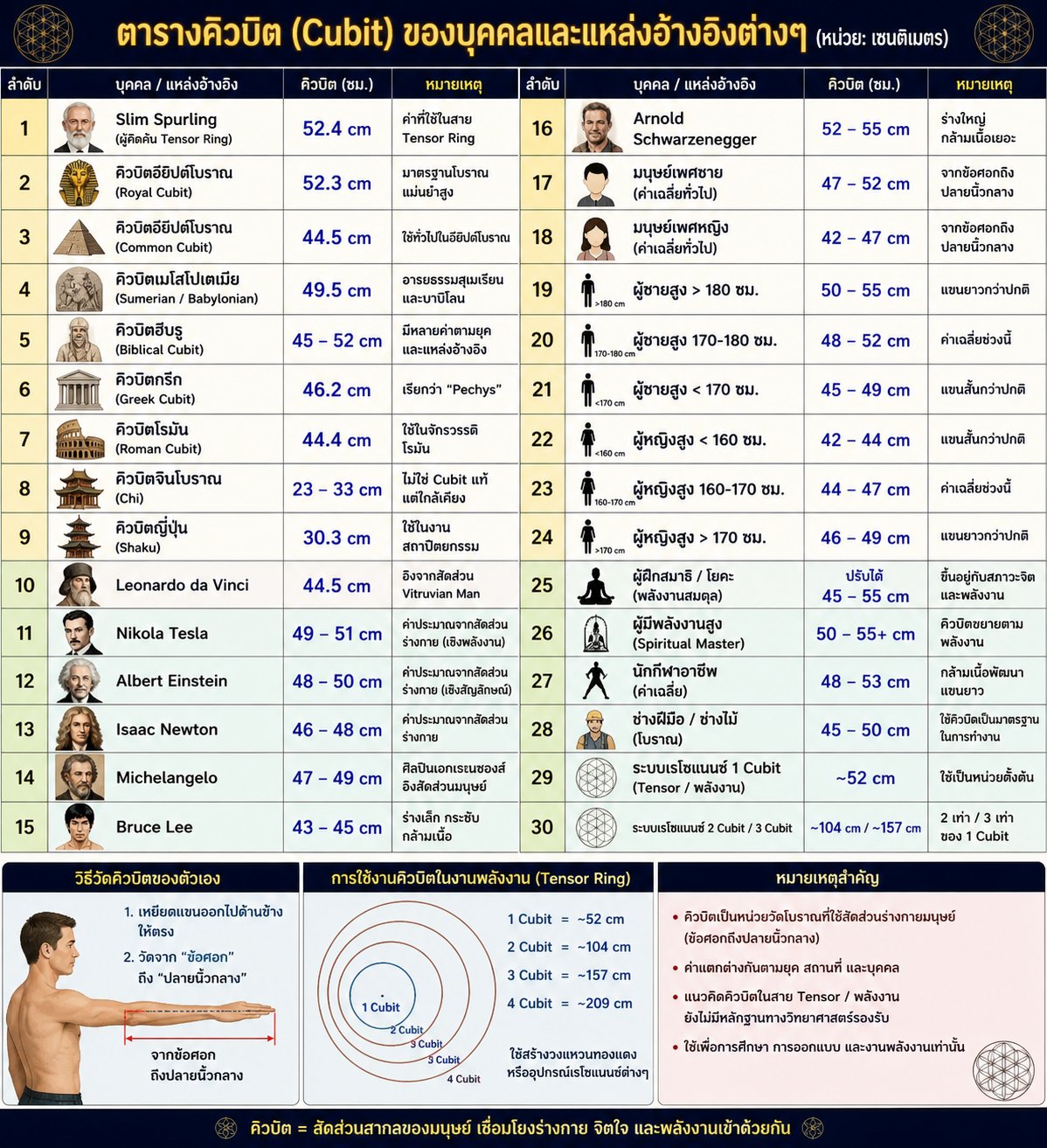
Click image to enlarge
📜 History — 5,000 Years of a Sacred Measure
Origins in Mesopotamia and Egypt
The Cubit first appears on tablets from the Sumerian kingdom (around 3000 BCE), before being refined into the Egyptian Royal Cubit during the reign of Pharaoh Djoser (2670 BCE). The architect Imhotep used it to design the Step Pyramid at Saqqara. The Egyptian Royal Cubit measured 523 mm ± 0.5 mm across the entire kingdom — a level of standardization documented in hundreds of bronze and wooden measuring rods recovered from tomb excavations.
Modern researchers like Sir William Flinders Petrie (1883) measured the Great Pyramid of Giza and found that every dimension — base, diagonal, height — was a whole number of Royal Cubits. The base perimeter equals 1,760 Royal Cubits, approximately 921.6 meters.
A Connection to Earth and the Stars
Archaeologist John Michell (1973) showed that the Egyptian Royal Cubit has remarkable proportional relationships with the Earth’s circumference:
- Earth’s equatorial circumference ÷ Royal Cubit = 76,800,000 (a whole number)
- Earth’s polar circumference ÷ Royal Cubit = 76,499,200 (close to 7.65 × 10⁷)
- 1 Royal Cubit × 10⁶ = 523 km, close to 1° of arc at the equator (~111 km)
These observations have led some researchers to hypothesize that ancient Egypt knew the Earth’s size with precision long before Eratosthenes (240 BCE). This remains a controversial hypothesis among mainstream historians but a recurring theme in alternative-history scholarship.
🌍 The Cubit Across World Cultures
| Culture | Cubit Name | Length | Era |
|---|---|---|---|
| 🇪🇬 Egypt | Royal Cubit (Mahe) | 52.3-52.4 cm | 3000 BCE |
| 🇸🇾 Sumeria / Babylon | Kush Cubit | 49.5 cm | 3000 BCE |
| 🇬🇷 Greece | Pechys | 46.3 cm | 800 BCE |
| 🇮🇹 Rome | Cubitus | 44.4 cm | 500 BCE |
| 📜 Hebrew (Bible) | Ammah | 44.5-52.5 cm | 1500 BCE |
| 🇮🇳 India | Hasta | 45.7 cm | 1500 BCE (Vedic era) |
| 🇨🇳 China | Chi (尺) | 33.3 cm | 2000 BCE |
| 🇲🇽 Maya | Hunab | 41.2 cm | 1000 BCE |
| 🌍 Medieval England | English Cubit | 45.7 cm | 1100 CE |
The diversity of Cubit values across cultures suggests that ancient peoples used the human body (elbow to fingertip) as a starting reference, then refined that into systems aligned with the sun, moon, and broader cosmic structure.
⚡ Slim Spurling — The Cubit Returns
Slim Spurling (William Joseph Spurling Jr., 1938-2007) was a Colorado-based metalworker and researcher who collaborated with Bill Reid through the 1980s and 1990s. In 1991, Hans Becker took the Egyptian Royal Cubit and the mathematics of Phi (φ ≈ 1.618) and derived a new unit he called the “Lost Cubit.” Spurling combined these two units with one he derived independently, formed copper rings using each, and measured the resulting frequencies with a Lecher Antenna.
Spurling’s work was documented in the book “Spirit of the Rings” (first published 1996, revised 2003) and continued through Light-Life Technologies (Colorado, USA), which still produces Tensor Rings to original specifications today.
📊 The 4 Cubits Used in Tensor Rings
| Cubit | Inches | cm | Frequency | Use (per tradition) |
|---|---|---|---|---|
| Sacred Cubit | 20.63″ | 52.4 cm | 144 MHz | EMF environmental balancing · Egyptian Royal Cubit |
| Lost Cubit | 23.49″ | 59.67 cm | 177 MHz | Discovered by Hans Becker (1991) · body-focused |
| Slim 188 | 28.85″ | 73.28 cm | 188 MHz | Large size · meditation and consciousness |
| Yeshua Cubit | 25.20″ | 64.0 cm | ~165 MHz | Smaller ring · meditation and spiritual practice |
Note: These frequencies are values that Slim Spurling, Hans Becker, and their lineage measured using a Lecher Antenna. Mainstream RF spectrum analyzers may not detect these signals directly because Spurling’s scalar field theory describes a wave that is not standard EMF.
🎯 Why Does ±1 mm Matter?
If the wire length deviates by more than ±1 mm, the resulting frequency shifts — much like a radio tuned 1 KHz off station: the signal disappears. Mathematically: if the standard Sacred Cubit is 524 mm and you deviate by +1 mm to 525 mm, the measured frequency drops about 0.19% — from 144.0 MHz to roughly 143.7 MHz. A Lecher Antenna detects deviations of this magnitude immediately.
A Tensor Ring cut without strict Cubit precision is not just “the wrong size” — it fails to resonate at 144 / 177 / 188 MHz as Slim Spurling and Hans Becker recorded.
📏 How to Measure a Cubit — Science and Craft
-
1 · CALIBRATED REFERENCE
Start with a calibrated steel rule (traceable to NIST standard if possible). Plastic and fabric rulers stretch with temperature, which can introduce Cubit drift over time. -
2 · LASER DISTANCE METER
Use a laser tape measure (Bosch, Leica) and verify it against the steel rule. Laser meters reach ±1 mm precision at 5 m range. -
3 · CALIBRATION JIG
Build a wood or aluminum jig with the Cubit pre-marked. Cut every wire on the same jig — this keeps every ring’s circumference within ±0.5 mm of the others. -
4 · POST-FORMING VERIFICATION
After forming the ring, measure circumference again with a flexible tape. If it deviates by more than 1 mm, scrap and re-form. -
5 · LECHER QC (OPTIONAL)
Use a Lecher Antenna to confirm resonance at 144/177/188 MHz before shipping. This tool is outside mainstream science but is the standard within the Slim Spurling tradition.
🌟 Sacred Measurement in Ancient Cultures
The first ancient Egyptian architect to use the Royal Cubit in building the Step Pyramid at Saqqara (2670 BCE). Often called “the first modern designer” in human history.
Leonardo da Vinci (1490) drew the human figure inscribed in a circle and square, using the Cubit as his unit — revealing Phi (φ) proportions in the human body, following the Vitruvius tradition (Rome, 15 BCE).
Genesis 6:15 specifies the ark’s dimensions as 300×50×30 cubits. If the Hebrew Cubit is ~52.5 cm, the ark would be 157×26×16 m — larger than an Olympic-class RMS vessel.
Vastu Shastra uses the Hasta (Hindu Cubit ≈ 45.7 cm) to design temples and homes. Every space is a whole number of Hastas to create “good frequency” alignment.
The Mayan calendar uses Hunab as a measurement unit, aligned with the Venus cycle (584 days), suggesting deep astronomical understanding.
Thailand has “Keub” (~25 cm — half a Cubit) and “Sok” (~50 cm, very close to the Sacred Cubit). Old Thai temples used “Sok” in pagoda construction.
❓ FAQ — Common Questions
A: The “main” Egyptian Royal Cubit was 52.4 cm, but actual measuring rods recovered from tombs range from 52.3-52.5 cm — a 0.2 cm tolerance, which is remarkable precision for 3000 BCE. There was also a “Short Cubit” (44.4 cm) for everyday use plus the Royal Cubit (52.4 cm) for sacred architecture.
A: The name “Lost Cubit” (1991) suggests Hans Becker believed this unit existed in ancient cultures and was forgotten. He calculated it from Sacred Cubit × Phi (φ) ≈ Sacred × 1.618. There is no archaeological evidence that any specific culture used this unit, but it was a mathematical “rediscovery.”
A: In a sense, yes — Sacred Cubit (52.4 cm) × φ (1.618) ≈ 84.78 cm, which is close to the Lost Cubit (90.07 cm). Phi relationships are documented in the Khufu pyramid, the Vitruvian Man, the Fibonacci sequence, and nautilus shells. Alternative-history researchers interpret this as evidence that ancient peoples understood Phi 5,000 years ago.
A: He didn’t choose — he measured. When copper wire is cut to a Cubit length and the ends are joined, Spurling measured the resulting frequency with a Lecher Antenna and recorded: Sacred Cubit → 144 MHz, Lost Cubit → 177 MHz, Slim 188 → 188 MHz. These are the natural behavior of rings at those Cubit sizes.
⚖️ Honest Disclosure
- ✅ The Egyptian Royal Cubit (52.4 cm) — supported by archaeological evidence from hundreds of measuring rods
- ✅ The Giza pyramid uses the Royal Cubit — measured by Sir William Petrie in 1883
- ✅ The Cubit appears in many world cultures — supported by Mesopotamian, Greek, Roman, Indian, Chinese, and Maya evidence
- ⚠ Earth circumference ÷ Cubit = whole numbers — a mathematical observation that mainstream archaeologists still debate
- ❌ Slim Spurling Cubit and frequencies (144/177/188 MHz) — Spurling/Becker field research has no peer-review and uses the Lecher Antenna, which lies outside mainstream science
- ❌ Tensor Rings “heal” — no medical research supports this. Tensor Rings are handcraft jewelry, not medical devices
- ✅ The Sacred Cubit math is geometry — verifiable in any classroom with a ruler